
November 2006
Monthly Archive
Search Marketing - SimplifiedMonthly Archive
Posted by Dave Pye on 30 Nov 2006 | Tagged as: Blog Marketing, Content
By now there are Amish people who can tell you blog marketing can work wonders driving traffic and leads to your business. But after you take the time to build one on your site, don’t expect Shoeless Joe Jackson to immediately show up and start hitting runs for the home team. Blogging is hard work, and the internet is littered with the bones of thousands of abandoned ideas, usually with “ramblings” or “musings” somewhere in the title.
Momentum is a tough thing to perpetuate. For every day you don’t post on your blog, you can almost devise a mathematical formula that will exponentially measure the traffic you’re going to lose forever. If you aren’t naturally prolific, and you’re not paying someone else to keep your company blog oven fresh, there’s some easy rules of thumb that will help you through.
Maintaining a company blog is a lot like having a puppy. If you don’t give it water it will die. Don’t adopt a blog until you realize the responsibility attached to keeping it alive. And if you’re still interested afterwards, remember my three simple tips. Housetraining WordPress is up to you.
Blog Marketing Content Field of Dreams Niche BloggingPosted by Dave Pye on 29 Nov 2006 | Tagged as: Keyword Research, Social Media Optimization
People who run around deliberately trying to coin phrases are like people who refer to themselves in the third person - they should immediately be lined up against a wall and shot with paintball pellets from 3 feet away until they cry. But sometimes a new word or acronym just happens virally and becomes an unstoppable addition to vernacular. “SMO” (Social Media Optimization) is a great recent example. “Fo’ Shizzle” (?) not quite so much.
I have coined a phrase around my office that I quite like - so I’m going to put it out there and see what happens. I have a better chance of seeing a one-legged cat bury a turd on a frozen pond than to have this blow up, but I’m willing to try anything once. MVK (Most Valuable Keyword/s) is how I refer to a client’s tip-top words and phrase iterations. I like to see it limited to 5 examples, and that’s probably unconsciously due to extended use of the free version of Web CEO, but I’m flexible.
I now feel inclined to explain why I started to do this. I suppose the term was spawned out of a want of efficiency and consistent intern/employee comprehension. There are many ways to describe said 5 terms: the SERP wishlist, top target market terms, the short tail, the lake house, the Ferarri 5, the lantern-rubbings, etc. Before this gets too silly, I’ll wrap it up and await the flood of phrase coining traffic. At least I didn’t write another top 10 list.
Keyword Research Social Media OptimizationPosted by Dave Pye on 21 Nov 2006 | Tagged as: Consumer Confidence, General Marketing
Search marketing has fast become an essential means of purveyance and revenue for todays online retailers. I mean, that’s why we’re all here, right? As I prepare a quick client report on the reasons to aggressively ramp-up PPC spending for this most lucrative of seasons, I thought I’d spread a little cheer in the form of some findings. Normally I spread cheer by spiking the egg nog with a fifth of Gosling, but it’s only November and there’ll be plenty of time for that too.
According to Nielsen, online holiday shopping totaled $30.1 billion during the 2005 holiday season (October 29 – December 23). And that was a 30% increase over 2004. If the same spike were to happen again this year, which is well within realistic estimates, we could be looking at a 2006 “espend” in the neighborhood of 40 billion of your American dollars, Mr. Bond. Again, this is online purchasing alone, and there’s a simple underlying and fundamental reason for this consistent growth.
I use the word “confidence” frequently on this site, and I’m about to use it yet again. Everything your online marketing efforts strive to accomplish should have the final goal of creating consumer confidence in the crosshairs. Create it, foster it, hug it, feed it, keep it warm and then release it into the wild. The wild, of course, being the checkout confirmation page of your shopping cart.
As we head into 2007 and beyond, scores more people are fully comfortable shopping online. But what has changed recently is that these consumers now have good experiences to draw on, and are more trusting of online merchants, warrantys and especially - delivery dates. If I had ever managed to get my grandmother past Freecell in terms of computer use, here’s how our yearly conversations might have evolved:
And… scene. I hope I managed to make some semblance of a silly point. Revenues are skyrocketing because people aren’t afraid to shop online anymore. And more importantly, they have faith that what they order for their loved one is actually going to arrive on time. So in addition to a larger number of purchases, they are making said purchases later and later into the season - thus also contributing to the boom. It’s an exciting time to be in marketing, pass the egg nog.
Posted by Dave Pye on 16 Nov 2006 | Tagged as: Meta Tags, MSN, Site Structure
If you’re focusing 100% of your SEO time on catering to Google’s royal highness - frankly no one is really going to blame you. But as Google, Yahoo and MSN compete aggressively for search market share, they also strive to differentiate themselves from eachother. One of the ways in which they do this is by having their algorithms interpret sites in alternate ways. So if you want an SEO strategy that is going to be truly comprehensive, you should be aware of what the red headed stepspiders are looking for when they visit your site, too.
So what do we know about the different ways the top 3 assign natural ranking? Nutshell:
That’s way oversimplified, I know. Spare me. Of the three MSN/Windows Live seems to be the least considered or talked about, so let’s dig a little deeper. I already mentioned internal linking structure, and that topic is worthy of its own future post. Quickly, it means that you link to pages within your own site using targeted keywords. Sort of like a mini sitemap on every page, but with very specific iteration choices in the link text (see what I just did there?).
And we all probably know what a one-way, incoming link is by now. So what else differentiates MSN from the competition? Some SEO companies will tell you that meta tag importance has gone the way of the DoDo. Others will tell you that meta optimization is part of any comprehensive SEO effort. The former is true if you only care about Google, as their algorithm largely ignores meta data. But MSN holds meta data in very high regard - so the latter is also true. MSN is a true meta search engine, so this area should not be overlooked or considered a throwback based on what Google’s algorithm happens to be doing.
Other MSN idiosyncrasies include a dislike of nested tables (another reason to start using CSS) and a more liberal stance on keyword density levels before they are considered spam. But the real point to take away from this article is that the meta tag is not dead. And remember - With Gates and Microsoft behind Windows Live, there is no such thing as a development or marketing ceiling for this product. They should be taken very seriously by internet marketers, as not even The Shadow knows what’s going to happen to market share percentages in the next couple of years. Because I think Microsoft just bought him.
Meta Tags MSN Site Structure UncategorizedPosted by Dave Pye on 13 Nov 2006 | Tagged as: Site Structure, Search Engine Optimization
What is a redirect, and why are they a frequently employed facet of web navigation? Picture a bored traffic cop trying to manage a detour after a bridge has collapsed. Due to habit and training, said traffic will automatically try and cross the bridge - so to avoid disastrous, albeit probably humorous, consequences this traffic must be redirected to a safe, alternate route. The same is true after a website alteration. It may take months for search engines to reindex and reflect your new URL structure or domain name. So in the meantime, and likely permanently, a similar technical detour should be implemented to keep you from losing valuable traffic to the ether.
Redirects are the genesis of a lot of confusion in the wild, wide world of SEM - because if applied for the purposes of black hat SEO, they can get you penalized. It was common practice in the early days to set up groups of sneaky redirection pages that all targeted similar and related keywords or phrases. The only links on these pages are links to other pages in the same family creating a phony sense of related linking that once managed to trick algorithms. But the 301 redirect is completely safe and should not be feared.
For a practical example, if you have removed or renamed a page on your site, and want to avoid displaying a 404 error page, set up a 301 redirect to push traffic to your new page. The code 301 means “moved permanently” and it’s the easiest way to preserve your search engine rankings for that page. Redirects are implemented differently depending on the language your site has been written in. What works for PHP won’t work for .NET and so on. The common element of the 301 redirect is that they are always easy to implement. Have a look at these multi-platform instructions and don’t fear the redirect!
301 redirect htaccess Search Engine Optimization Site Structure Uncategorized urlPosted by Dave Pye on 09 Nov 2006 | Tagged as: SEO Tips, PDFs, Search Engine Optimization
Although PDFs shouldn’t take the place of HTML in terms of spider bait, you may have salespeople on the road or prospective clients who need quick access to your catalog by way of the Portable Document Format. So we don’t want to convert PDFs to HTML and then deep six them – they do not have to be mutually exclusive. Rather, we want to convert them to HTML and optimize the PDFs so they are organically searchable. If we want to keep them live for easy download, we may as well follow the simple steps that will render them indexable by Google while we’re at the squaredance.
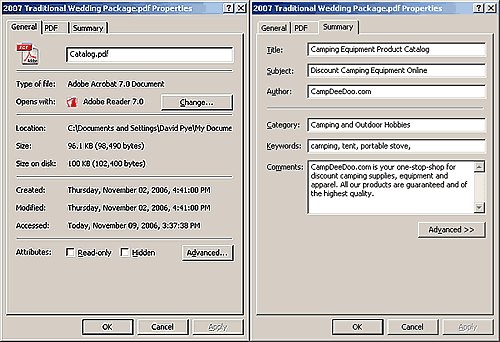
So the million dollar question becomes how does one optimize a PDF for search? It’s actually quite simple - for every document you publish online, you should clearly define both the title and description in the document’s properties. To do this, right click on the PDF in question and select ‘Properties’ at the very bottom of the navigation menu. The following window should pop-up (These are two tabs of the properties window placed side-by-side to save space):

The top form allows you to change the document’s file name. I would recommend including keywords, separated by hyphens and not underscores. So, “online-catalog.pdf” could become “specific-discount-stuff-we-sell-catalog.pdf” or some variation. I have used a fictional camping store for the graphic example, in which case an ideal filename might be “discount-camping-equipment.pdf”. Don’t feed the bears, do feed the search engines.
The next step is to click on the ‘Summary’ tab. The possibilities here are pretty self explanatory - Titles, Subjects, Authors and even a selection of related keywords can be populated from this tab. Use this capability to its full potential and fill in your business or file-specific information. By default, this will be blank, so stuff it full of juicy data for the search engines. And voila, you’re just drastically increased the likelihood of your document showing up in natural search.
A few other notable points - Once Google has indexed your PDF relevantly thanks to your taking the time to fill out the properties information, it can index the text contained within. It may have already done this for some of your documents – but take the time to optimize the tags regardless. Titles, Subjects and Company Names will help intuitiveness when humans see at your PDF on search engine results pages. URLs in PDFs are often counted by spiders as precious backlinks – so proper hyperlinks should be included in all documents before they are converted to PDFs. Finally, Google also seems to hold PDFs in a positive light because they are completely impervious to comment spam. Read more from the horse’s mouth here.
PDFs Search Engine Optimization SEO TipsPosted by Dave Pye on 07 Nov 2006 | Tagged as: Social Media Optimization
Social media marketing is so painfully new, and there is such an unfocused buzz around it, that it is easy for the laybusinessperson to get completely overwhelmed. Is there any difference between SMO and SMM, for example? How can MySpace and Digg both be categorized as social/new media when they are fundamentally so very different? And, more importantly, how can I claim my own plot and start prospecting?
The strokes are very broad right now, and subcategories that are going to help the layperson understand the new landscape are emerging. The best breakdown I’ve found is Ben Wills’ Five Pillars of Social Media Marketing - but I will try and form some original thoughts for the less experienced. Marketing 101 tell us to identify our target market before even getting out of bed in the morning. So boil it all down and think about which new media outlets your targets are most likely to be converging at. Let’s look at a few of the juggernauts.
MySpace’s audience might be completely useless to an accounting software firm. Likewise, an article about a band, comedian, Halloween costume coupon or movie will get buried quickly on a social voting site like digg. What’s good for one business in terms of social media may be completely irrelevant to another. First, understand what is out there and then focus on one or two SMM outlets or strategies that relate best to your business objectives and target market. There is no clear roadmap to capturing and selling to these huge built-in audiences, but it is definitely worth your time to try.
del.icio.us digg MySpace SMO Social Media Optimization Target MarketPosted by Dave Pye on 06 Nov 2006 | Tagged as: Press Releases, Content
Update: 6/13/07
Straight from the horse’s mouth (Vanessa Fox):
“Google wants to serve up unique results and does a great job of picking a version of your content to show if your sites includes duplication. If you don’t want to worry about sorting through duplication on your site, you can let us worry about it instead. Duplicate content doesn’t cause your site to be penalized. If duplicate pages are detected, one version will be returned in the search results to ensure variety for searchers. Duplicate content doesn’t cause your site to be placed in the supplemental index. Duplication may indirectly influence this however, if links to your pages are split among the various versions, causing lower per-page PageRank.”
Sorry to sound like Magnum P.I. - but I know what you’re thinking. Why are press releases and article distribution sites so very useful for SEO and branding, and yet you’re hearing warnings about duplicate content penalization everywhere you turn? Before Higgins releases the Lads, here are a few things you need to know.
If you’re up nights worrying about being penalized for offering an RSS feed or participating in other forms of syndication, you’re taking the term ‘duplicate content’ too literally. A press release or article which appears on more than one unrelated site is not going to get anyone penalized. The operative word here being unrelated. Not every website in the world can be 100% original, and multiple domains are naturally going to aggregate the same news, quotes and other content.
On the other hand, If you sell pet food, and you’ve registered petfoodrules.com, www.buycheappetfood.org, petfoodinmypants.net - and they all contain exactly the same content (copy, tags etc.) - now you’re playing with fire. And gosh help you if you’ve got them all on the same server/IP address. This is what is meant by duplicate content that can get you penalized. Pick one of the domains to focus on, implement 301 redirects on the others and stop being so silly.
If you’re very attached to your multiple domain strategy, and are of the opinion that penalization will never happen to you, bear in mind that one of two things is probably inevitable, at least within Google:
That sort of a slap can be dynasty-destroying. You’ll return to square one in terms of search engine visibility and be trying to get your old job at the liquor store back. Know what duplicate content is, what it isn’t - and then don’t do it. For more detail on the science of DC, including a break down of the different levels of severity, read this fantastic article by Todd Malicoat.
article syndication Content duplicate content Press Releases